
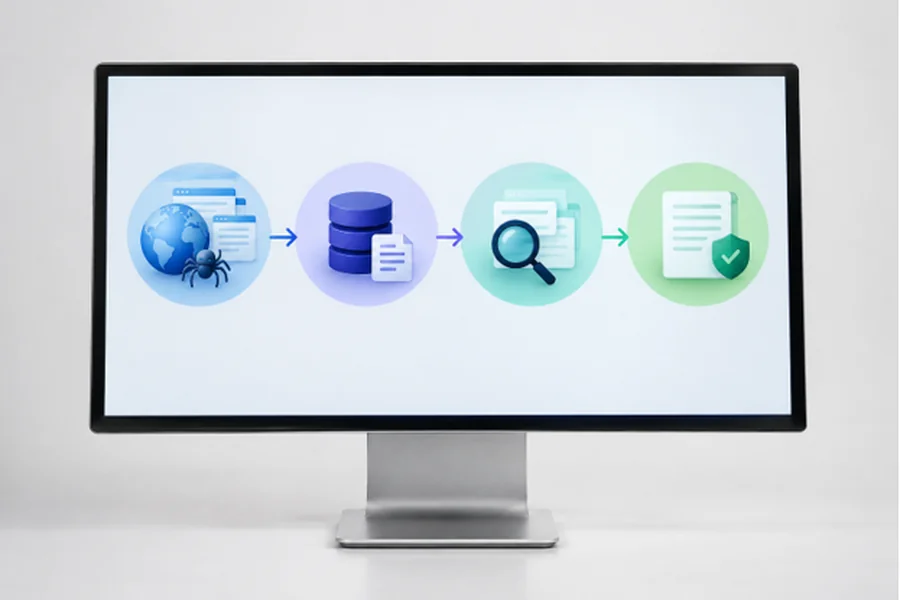
AI can produce useful research only when it can locate relevant information, distinguish strong evidence from weak material, and retain the details that matter. That is why the choice among search tools, databases, and Exa competitors should begin with more than just answer quality. The underlying discovery and retrieval process determines whether an answer is current, traceable, and appropriate for the question.
A language model may have broad general knowledge, but live research depends on what it can retrieve at the moment of the request. For changing subjects such as regulations, product announcements, market activity, or new scientific findings, a dependable workflow needs fresh sources, careful ranking, and a final review against the evidence.
Why Web Crawling Matters for AI Research
Web crawling is the process of using automated software to discover and fetch publicly accessible pages, documents, and other resources. Crawlers commonly find material through links, sitemaps, known URLs, and signals that a page has changed. Without this discovery layer, a research system has a much smaller and less current pool of information to search.
Fresh access matters when the answer could change. A request about a newly issued rule, a revised product specification, or a recently published study should not be answered solely from older model knowledge. Still, access to a larger collection of pages does not automatically create a better response. The system must identify which sources directly address the question and deserve trust.
How Crawling, Search, and Indexing Work Together
These stages are connected, but they perform different jobs. Automated web crawlers find and process pages before search systems can serve relevant results. Understanding the separation helps teams diagnose why an important source was missed or why a poor one was selected.
- Crawling: Software discovers and retrieves pages that it can access.
- Indexing: The system extracts, analyzes, and stores useful content for later search.
- Retrieval: A search process selects material that appears relevant to a specific question.
- Answer generation: An AI model interprets the retrieved material and drafts a response.
A page can be crawled but not indexed. It can be indexed but rank poorly for a query. It can rank well but still be unsuitable for an AI answer because it is outdated, incomplete, or off-topic. Links, clear page structure, accessible content, and update signals all improve the odds that useful material can move through this pipeline.
Why Data Quality Shapes AI Answers
Retrieval quality begins with source quality. Useful signals include clear authorship, a visible publication or update date, direct relevance, internal consistency, and support from primary evidence. Official records, original research, technical documentation, and direct statements are often more valuable than pages that merely repeat a claim.
Duplicate articles, scraped text, broken pages, and old summaries create noise. If ten pages repeat the same unsupported statement, the system has not found ten independent confirmations. A better process groups near-duplicates, prioritizes original reporting or records, and gives more weight to sources that provide specific evidence.
The Main Parts of an AI Retrieval Workflow
From a broad question to a supported answer
- Plan the query: Break a broad request into smaller research tasks.
- Discover sources: Find pages, reports, records, datasets, and documentation.
- Extract content: Keep the meaningful text while excluding navigation, ads, and scripts.
- Filter results: Remove irrelevant, duplicate, inaccessible, or stale material.
- Rank evidence: Sort remaining sources by relevance, credibility, and likely usefulness.
- Build context: Provide enough source material for the model to preserve important qualifications.
- Check the answer: Confirm that major claims match the retrieved evidence.
Context building deserves special attention. Too little material can omit a key exception. Too much loosely related material can distract the model or cause it to blend facts from different situations. The goal is not to collect everything. It is to assemble the smallest evidence set that can answer the question accurately.
Common Risks in Web-Based AI Research
- Stale information: A once-accurate page may no longer reflect current conditions.
- Source confusion: Facts from different dates, places, versions, or organizations can be combined incorrectly.
- Popularity bias: Highly linked or frequently copied pages may crowd out more authoritative material.
- Access limitations: Paywalls, login requirements, robots rules, JavaScript-heavy pages, and unstable sites can limit retrieval.
- Prompt injection: A page may contain instructions intended to manipulate an AI system rather than provide evidence.
- False confidence: Clear writing can conceal weak sourcing or unresolved uncertainty.
A Better Process for Source-Based AI Research
A practical workflow starts with a narrow question and an explicit time boundary when the topic changes quickly. Search for primary material first, use independent sources for important claims, and record the page section that supports each conclusion. Treat facts, estimates, opinions, and predictions as separate categories.
For example, replace the weak request “What is happening with this new law?” with a plan that identifies the law’s official text, confirms its effective date, reviews agency guidance, finds reliable reporting on implementation, and lists any open questions. The AI should flag missing evidence rather than invent a bridge between incomplete sources.
How to Measure Search and Retrieval Quality
Teams should test research workflows using real questions, not polished demonstrations alone. Useful measures include:
- Relevance: Whether the retrieved material answers the actual question.
- Precision: How many top results are genuinely useful?
- Recall: Whether the process finds the important available sources.
- Freshness: Whether dates are appropriate for the subject.
- Coverage: Whether the evidence includes the necessary source types or viewpoints.
- Answer support: Whether each major claim can be traced to evidence.
- Latency and cost: Whether the process is fast and efficient enough for its purpose.
What Comes Next for Web Search and AI
Publishers increasingly need clearer ways to control how automated systems use their material. The debate is not limited to whether a crawler should be allowed or blocked. It also concerns different uses, including search discovery, answer generation, and model training. Publishers may want to remain discoverable in search while limiting other automated uses, which makes purpose-specific controls and reliable crawler identification increasingly important.
Specialized systems for news, shopping, coding, research, and private enterprise knowledge will continue to raise the value of precise retrieval. Strong source tracking, permission signals, change detection, and human review will remain especially important when research affects legal, medical, financial, scientific, or public-policy decisions.
Conclusion
Reliable AI research requires more than a capable language model. It depends on thoughtful crawling, well-maintained indexes, relevant retrieval, high-quality evidence, and a clear process for checking what the system does not know. When search is treated as evidence gathering rather than a shortcut around judgment, AI answers become easier to verify and more trustworthy.